| TRIP PUTS UTAH'S GRANDEUR IN FOCUS
Special to the Mercury News Whoosh. A burst of flames erupts
above my head. My two
children crouch near my
feet. We're hanging a thou-
sand feet above rocky
desert terrain, next to a
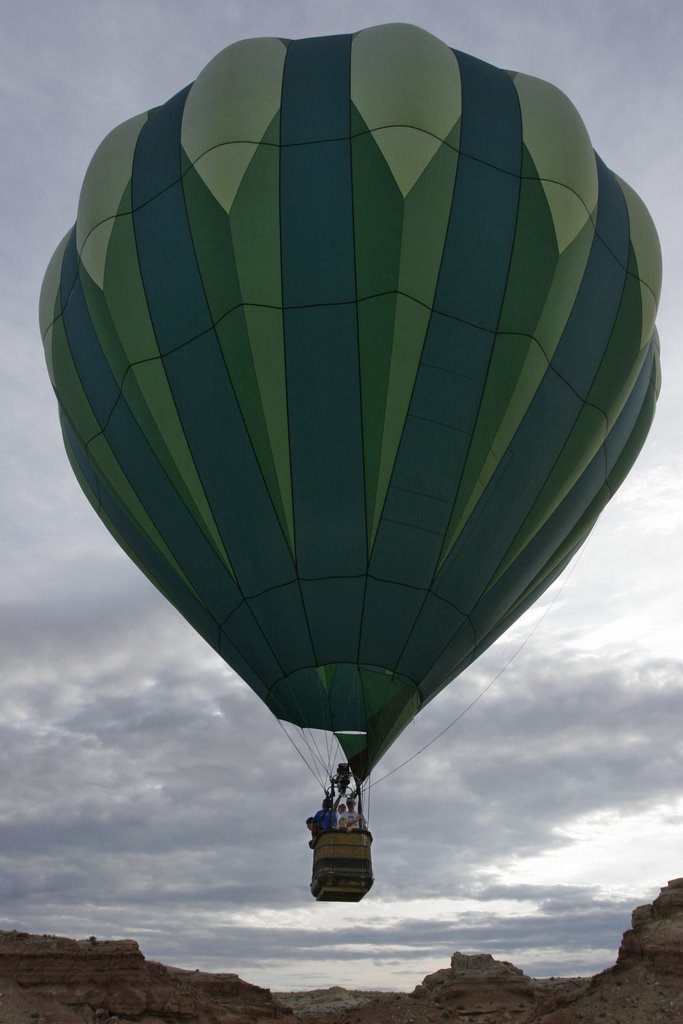
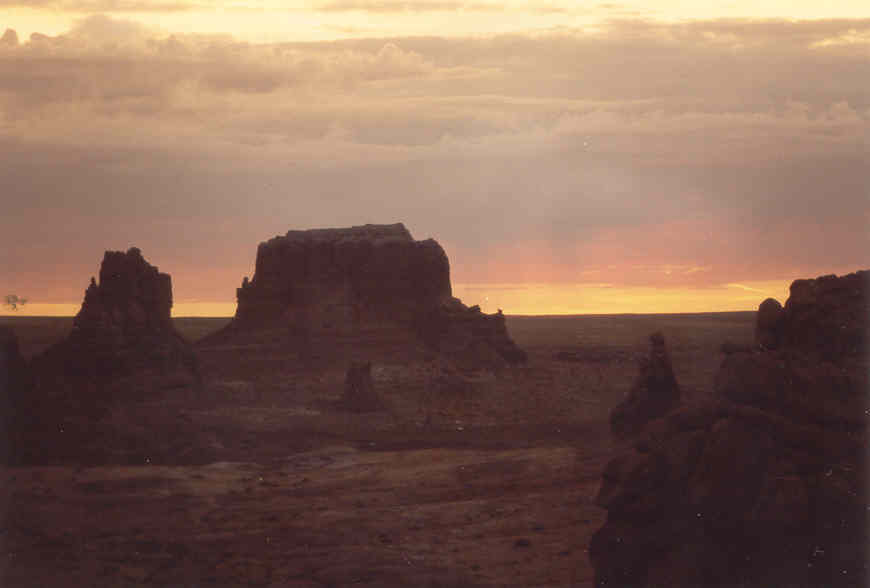
guy clutching an enormous blowtorch. Every few seconds he squirts blazing propane skyward, moving as serenely as if he were casting for trout. Whoosh. If life, as I know it, ends soon, at least my final moments will be scenic. The view up here is magnificent. When our family of four decided to make a road trip this summer from California to Colorado, we figured the shortest route to sanity was to pause the driving for a few diversions along the way. Ghost towns and scenic hikes topped our list. So did a jaunt on Highway 375 through Nevada, the ``Extraterrestrial Highway,'' a straight shot past the outskirts of the Air Force's mysterious Area 51. We even planned a lunch at the aptly named ``Little Ale-Inn Cafe,'' a friendly roadside diner loaded to the gills with alien kitsch. Those stops were just the warm-up act for the Grand Adventure: a balloon trip in southern Utah over the spirals and chasms of Bryce Canyon. The idea sounded marvelously romantic when my husband broached it: We would take off at dawn, waft amid the caramel-colored rock formations near Bryce for an hour or two, then alight and spend the day scampering through the canyons. Dorothy and Toto had big plans for their balloon trip from Oz, too. Before we signed a deposit for an hour balloon tour, prudence suggested we take a look at the safety record of hot-air balloons in the United States. When you think about it, ballooning seems like a crazy stunt: You fill an enormous silk canvas with air, heat it to about 240 degrees Fahrenheit with a blowtorch, leap into a wicker basket and head off. There are no life vests, no escape hatches and no parachutes. The National Transportation Safety Board obligingly lists all the accidents and incidents for airborne vehicles, back to the 1960s. (See www.ntsb.gov/ntsb/query.asp.) The numbers are reassuring -- sort of. During the past 10 years, the NTSB has reported 164 ``incidents'' caused by hot-air balloons, including 13 fatalities. (The most recent of these took place in Louisiana in May 2005.) By contrast, gliders have caused twice as many problems and five times as many deaths. Of course, flying a balloon into power lines causes huge problems. So, too, does flying in thunderstorms, or turning the controls over to passengers. Commercial ballooning pilots have to be at least 18 years old and log at least 10 flights and 35 hours in the air. We wanted someone who had spent plenty of time amid the clouds. And since we wanted to soar over some remote locations, we called Will Drummer, who runs Skywalker Balloon Co. Drummer, a native of Austria, first visited southern Utah as a tourist more than 10 years ago and was dazzled by the landscape. ``After I got back to Vienna, I spent a year thinking about how to make a living showing people the Utah countryside,'' he says. Ballooning called to him. He headed back to Utah, spent 18 months working as a crew member for a ballooning company, then set up his own outfit in 1996. Since then, Drummer has logged more than 500 hours of balloon flight time -- enough to soothe our nerves. We agreed to meet Drummer at Bryce the evening before our flight, where we would camp. The day before our launch dawned clear and bright where we were -- Tonopah, Nev. But when we checked with Drummer by phone, he sounded gloomy. Thunderstorms were skulking around Bryce, he reported. With little slack in our travel schedule, bad weather would not only thwart our adventure but also cost a 25 percent cancellation charge against our $1,000 flight fee. Should we take our chances and hope for the best? Tell Drummer we were willing to run the risk that there might be a thunderstorm within a hundred miles of our launch? No. We had picked a cautious pilot with loads of experience; we'd follow his recommendations to the letter. Drummer's advice was to head another 180 miles northeast to a lesser-known canyon, Goblin State Park, where the weather reports looked sweet. Goblin was his personal favorite, he confided, a surreal landscape with fewer tourists. Getting to Goblin Valley would require a mad dash. But off we went. After a dinner stop, we drove until nightfall. The road turned from paved highway into one-lane roads and finally to dirt. Jackrabbits bounded out of the shadowed scrub, startled by our headlights. A lone sign pointed the way to Goblin. It was fortunate we had planned on camping; the nearest motel was about 15 miles away. When we rolled into the camping ground close to 10 p.m., the dark canyon walls rose around us like the sides of a swallow's nest. Lights glowed from the windows of a half-dozen RVs. We finally found Drummer and Matthew Hawk, his crew, who had arrived at the site several hours earlier. They were upbeat: We had evaded the thunderstorms. Stars glimmered. The night air was soft. Our two boys were nodding off. We skipped setting up the tent, laid out our sleeping bags in a sandy clearing and went to sleep as a shooting star or two winked at us. At 5:30 a.m., we shook the boys gently awake. Drummer and Hawk needed to find a site for our launch. Balloonists typically take off either at sunrise or a few hours before sunset, when the air currents are gentlest. We climbed into Drummer's pickup truck, which was pulling a trailer neatly packed with the balloon's wicker basket and folded silk canopy, and drove to a lookout spot above the Valley of the Goblins. Sunlight began to paint the horizon red and orange. The weird stones, called ``hoodoos,'' sculpted by millions of years of wind and water, cast eerie shadows. Drummer and Hawk inflated a small black test balloon with helium and set it aloft, watched its trail through the sky. Drummer frowned. The tiny black speck drifted east, toward an area with no accessible roads for retrieving the balloon once we landed. `It looks like a strawberry seed,'' said our 9-year-old, Matthew. Several test balloons later, Drummer still looked stern. We climbed into the pickup truck and headed to another spot two miles north. Gray morning light filled the desert. Seven-year-old Peter lay stomach-down in the red desert, eyeing half-inch-long beetles burrow in the sand. The rest of us watched in silence as more of Drummer's test balloons sailed off. At last, Drummer was satisfied. ``All right. Let's go!'' He pulled on a pair of white kid gloves and began unpacking the trailer. In less than 10 minutes, Drummer and Hawk attached the yellow and green silk canvas to the basket, secured the liquid propane burners, and were using a huge fan to push air into the belly of the balloon. They enlisted my husband's help to hold onto the basket as they fired the burners to begin to warm the air, which would lift the balloon. At first it was easy. Before long, my husband was straining with all his muscles to keep the basket in place. Finally, the moment came. Drummer gave us a short but stern safety talk: Never climb in or out of the basket until he gave the OK. Don't touch the balloon's controls. We scrambled into the basket. Hawk set us free. Drummer fired the burners. Whoosh. The balloon quivered, then floated gracefully off the ground. We drifted lazily into the sky. There is no steering wheel on a balloon; you go where the wind pushes you. The quiet of the desert surrounded us . . . until Drummer squeezed the handles of his burners and Whoosh! Another blast of heat would warm the air in the balloon and push us a little higher. ``The balloon doesn't leave a trail -- we don't even leave footprints,'' Drummer said. We drifted over the desert terrain, gazing at the buttes that rose like mushrooms, at grand cracks and crevices in the land, at a lonely narrow road that looped through the desert. Time seemed to slow down. Drummer, even as he vigilantly watched the land roll by beneath us, relaxed a bit and began to tell us about the history of ballooning. Ballooning started in France in 1783. Lore claims that the Montgolfier brothers, Joseph and Étienne, who owned a paper mill, marveled at how paper or laundry would rise in the updraft of a fire. Early experiments spooked farmers, who suspected the balloons were the devil's work and promptly shredded them. The Montgolfiers built a large balloon from paper, attached a platform to it, and set a sheep, a rooster and a duck aloft. There were no propane burners, of course, so they burned straw to heat the air. The balloon floated about two miles, landing in Versailles, before Louis XVI and Marie Antoinette. The brothers learned two lessons: that hot air would lift the balloon and that nervous farmers might kill them the moment they landed. They constructed another balloon of paper and silk, recruited two noblemen as passengers, and equipped them with two bottles of Champagne. One bottle was intended to be used as a fire extinguisher; the second would be rappelled down to the crowds just before landing. ``They figured that if the farmers were presented with Champagne, they would know the pilots were Frenchmen,'' Drummer recounted. After an hour of gazing at the Utah desert, Drummer began to look for a safe landing spot. He radioed Hawk, who had been following our progress, driving the pickup truck on the park roads below us. We descended gently, finally almost hovering about 10 feet off the ground. A light breeze nudged us along. For almost a half-mile, we floated along, as light as meringue. Finally, not far from the road and the pickup, Drummer set the balloon down with one quick bump. After our ride, Drummer and Hawk carefully packed up the balloon and basket, then cracked open the balloonists' now-traditional bottle of Champagne (along with some fizzy apple juice for the boys). Drummer recited the prayer of the balloonists: The winds have welcomed us with softness The sun has blessed us in its warm hands We have flown so high and so well That God has joined us in our laughter And gently set us back down Into the loving arms of Mother Earth. They gave us a lift back to camp, shared a couple of gallons of water and headed off, leaving us to explore Goblin Valley, find something to eat -- and imagine where else we might one day tour in a balloon.
|